Return on Investment Analysis for CNC engravers and Laser Machines

最後更新: 2026-04-14 6 Min 閱讀

數控與雷射加工業務投資報酬率:機器多久可以回本?

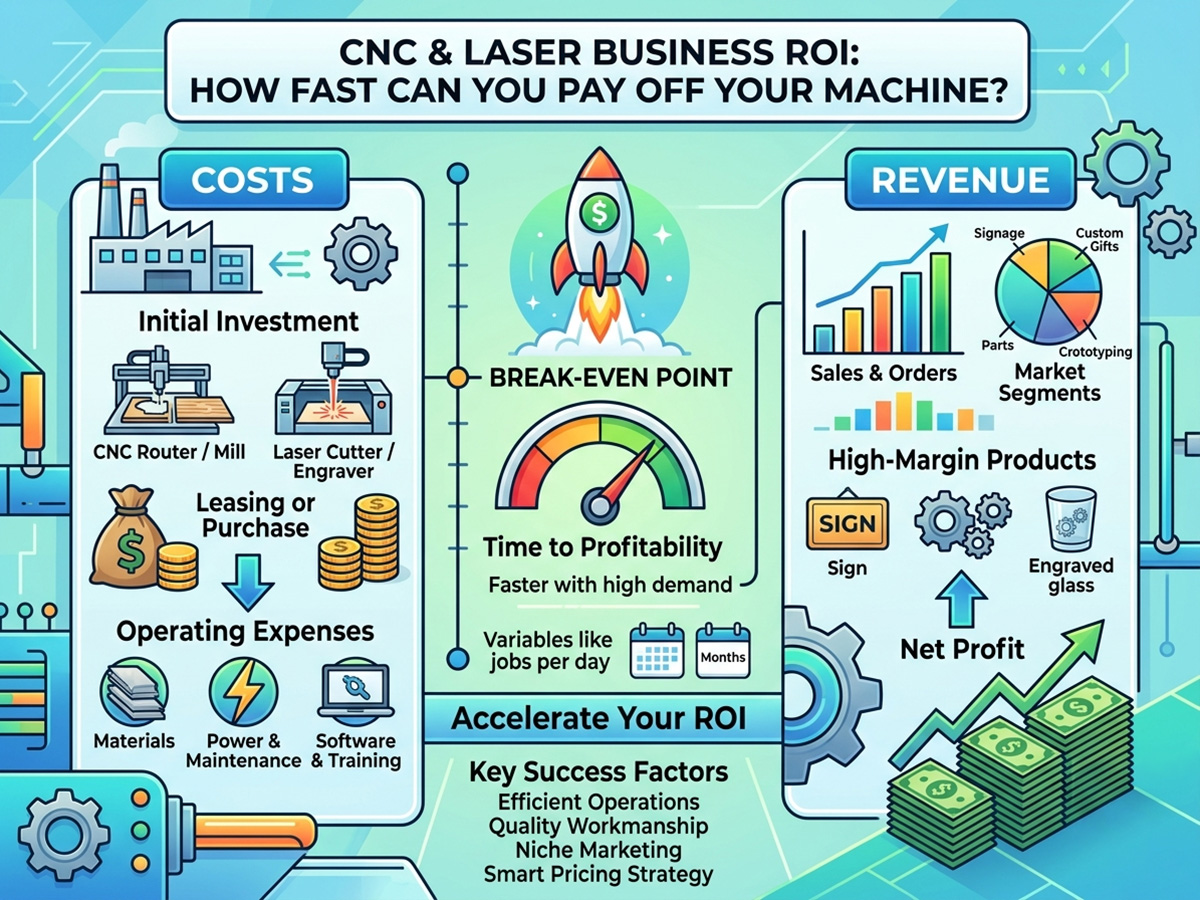
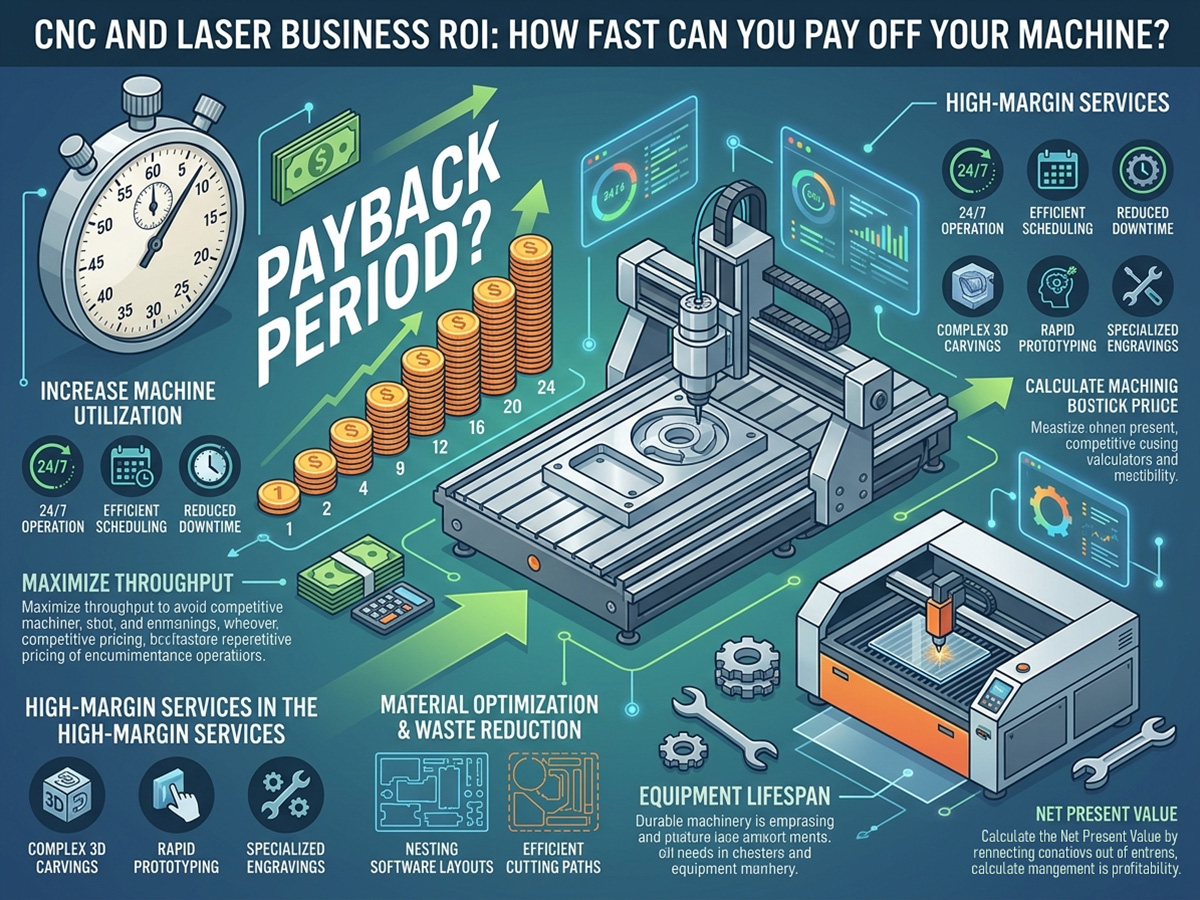
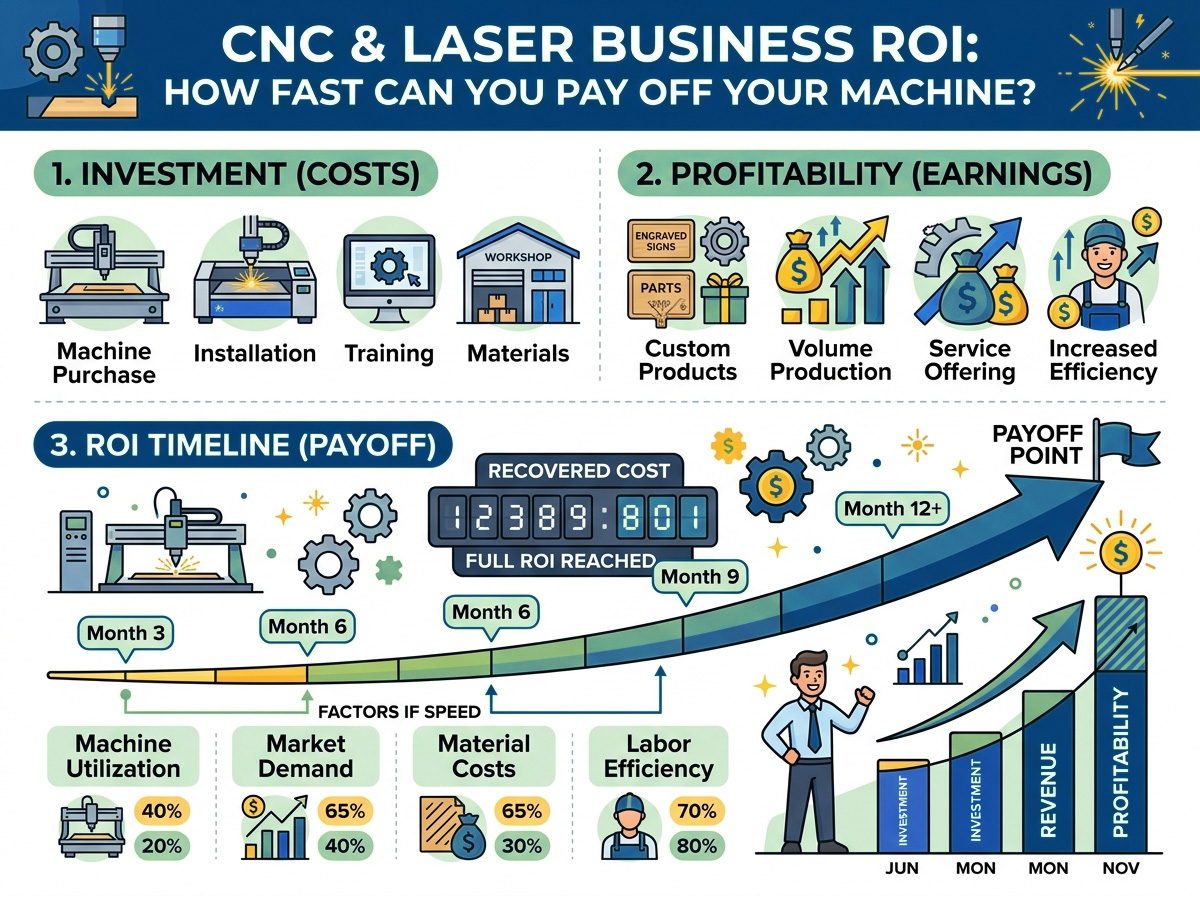
大多數數控雕刻機和雷射機可在 6 至 24 個月內收回成本,具體時間取決於機器類型、使用率和商業模式。售價低於 5,000 美元的業餘級機器通常可透過客製化產品銷售在 6 個月內實現收支平衡。工業光纖雷射切割機和全尺寸數控雕刻機在正常運作的情況下,通常在 12 至 18 個月內即可收回成本。 60% 或更高的利用率。關鍵變數是產量、定價策略和穩定的訂單流。

What Does ROI Mean for a CNC or Laser Business?

Return on investment (ROI) for CNC and laser equipment measures the total net financial benefit your machine generates divided by the total cost of owning and operating it. Unlike general business ROI, machine-level ROI factors in labor displacement, material waste reduction, increased production capacity, and the ability to take on higher-margin contracts that manual methods cannot support.

A positive and rapidly growing ROI means your equipment is outperforming older, slower, or manual processes. For shop owners evaluating a CNC雕刻機 or laser system, the ROI calculation provides the clearest path from capital risk to financial reward.

ROI Formula: (Annual Net Profit from Machine - Annual Operating Costs) / Total Investment Cost x 100.

數控與雷射加工業務投資報酬率:機器多久可以回本?

Typical Payback Periods by Machine Type

Payback periods vary based on machine category, price point, and how aggressively the owner pursues revenue. The table below summarizes realistic timelines drawn from manufacturer data and shop-owner reports across forums and industry surveys.

機器的種類投資範圍Typical PaybackMonthly Profit PotentialUtilization Target
Desktop CNC engraver2,000 - 8,000 美元3 - 8個月500 - 2,000 美元40 - 60%
Full-Size CNC engraver (4x8)15,000 - 60,000 美元8 - 18個月2,000 - 8,000 美元60 - 80%
CO2 雷射雕刻機2,000 - 15,000 美元4 - 12個月1,000 - 5,000 美元50 - 70%
光纖雷射切割機30,000 - 200,000 美元6 - 24個月5,000 美元 - 15,000 美元以上70 - 85%
CNC等離子切割機8,000 - 50,000 美元6 - 18個月2,000 - 7,000 美元55 - 75%
測量$(approx.)個月USD/monthBeam-on hours (%)

Shop owners on WOODWEB and Practical Machinist consistently report that well-utilized CNC engravers pay for themselves within the 1st year. One cabinetry shop investing $110,000 in a router and software recovered the full cost in 12 months by eliminating 2 employee positions and doubling production output.

Key Factors That Accelerate or Delay Your Payback

Factors That Speed Up ROI

• High utilization rate: Running your machine at 60% or more beam-on time compresses payback dramatically. Every 10% utilization gain can shorten recovery by roughly 30%.

• Repeat production work: Custom signs, cabinet parts, and engraved products with predictable demand create consistent revenue that supports monthly payments.

• Pricing discipline: Charging based on value delivered rather than time spent protects margins. Underpricing is the most common profitability killer among new CNC owners.

• Parallel productivity: While the machine runs unattended, operators handle assembly, finishing, or customer interactions. This effectively doubles shop output.

• Niche specialization: Targeting high-demand verticals like wedding keepsakes, corporate awards, architectural metalwork, or custom furniture yields higher margins than general fabrication.

Factors That Delay ROI

• Buying more machine than needed: Forum users on CNCZone and WOODWEB caution that overinvesting in capacity you cannot fill leads to crushing monthly payments without matching revenue.

• Neglecting software investment: Experienced operators emphasize that spending on quality CAM software is as important as the machine itself. Poor software limits what your hardware can produce.

• Extended learning curves: Complex operations like dovetail drawers or 3D relief carving require months of programming refinement before reaching efficient production speeds.

• Downtime from poor support: Machines sitting idle due to parts delays or service lag destroy ROI timelines. Operators on Practical Machinist stress the importance of choosing vendors with responsive technical support.

ROI Analysis for CNC engravers and Laser Machines

Real-World ROI Scenarios

Scenario 1: Small Woodworking Shop with CNC engraver

A 2-person woodworking shop invests $25,000 in a 適用於小型企業的迷你CNC雕刻機 use, including software. The machine handles sign cutting, plaque carving, and custom parts. Monthly operating costs run approximately $400 (electricity, tooling, maintenance). At 20 jobs per week averaging $150 per job, monthly gross revenue reaches $12,000. After subtracting $3,000 in materials and $400 in operating costs, monthly net contribution is $8,600. The machine pays for itself in under 3 months.

Scenario 2: Laser Engraving Startup

A home-based entrepreneur purchases a $5,000 CO2 雷射雕刻機 and sells personalized gifts on Etsy. Monthly expenses total roughly $300 (materials, electricity, platform fees). Selling 100 customized items per month at an average of $25 each generates $2,500 in revenue. Net monthly profit of approximately $2,200 means the machine breaks even in about 2 and a half months. Operators in the LightBurn Forum and Reddit r/lasercutting communities confirm that focused seasonal sellers often recover costs even faster during holiday periods.

Scenario 3: Metal Fabrication Shop with Fiber Laser

A fabrication shop currently outsourcing laser cutting spends $7,500 per month on external services. They invest $80,000 in a 光纖雷射切割機. Monthly operating costs (gas, electricity, consumables, one operator) total approximately $3,000. By bringing cutting in-house, the shop saves $4,500 per month net. Payback occurs in approximately 18 months, and every month afterward adds directly to the bottom line.

How to Calculate Your Own Payback Period

Use this step-by-step framework to estimate your specific machine payback timeline.

Step 1: Total your investment costs

• Machine purchase price (including shipping, taxes, and import duties)

• Installation, electrical prep, and ventilation setup

• Software licenses and training

• Accessories (rotary attachments, exhaust systems, tooling kits)

Step 2: Estimate monthly operating costs

• Electricity (500 to 1,500W machines cost roughly $20 to $75/month at typical rates)

• Consumables (bits, lenses, nozzles, laser tubes)

• Materials for your primary product lines

• Maintenance and preventive service

Step 3: Project monthly revenue

• Research market rates for your target products (custom signs, engraved gifts, cut parts)

• Estimate realistic production capacity per shift

• Use conservative numbers rather than best-case projections

Step 4: Apply the payback formula

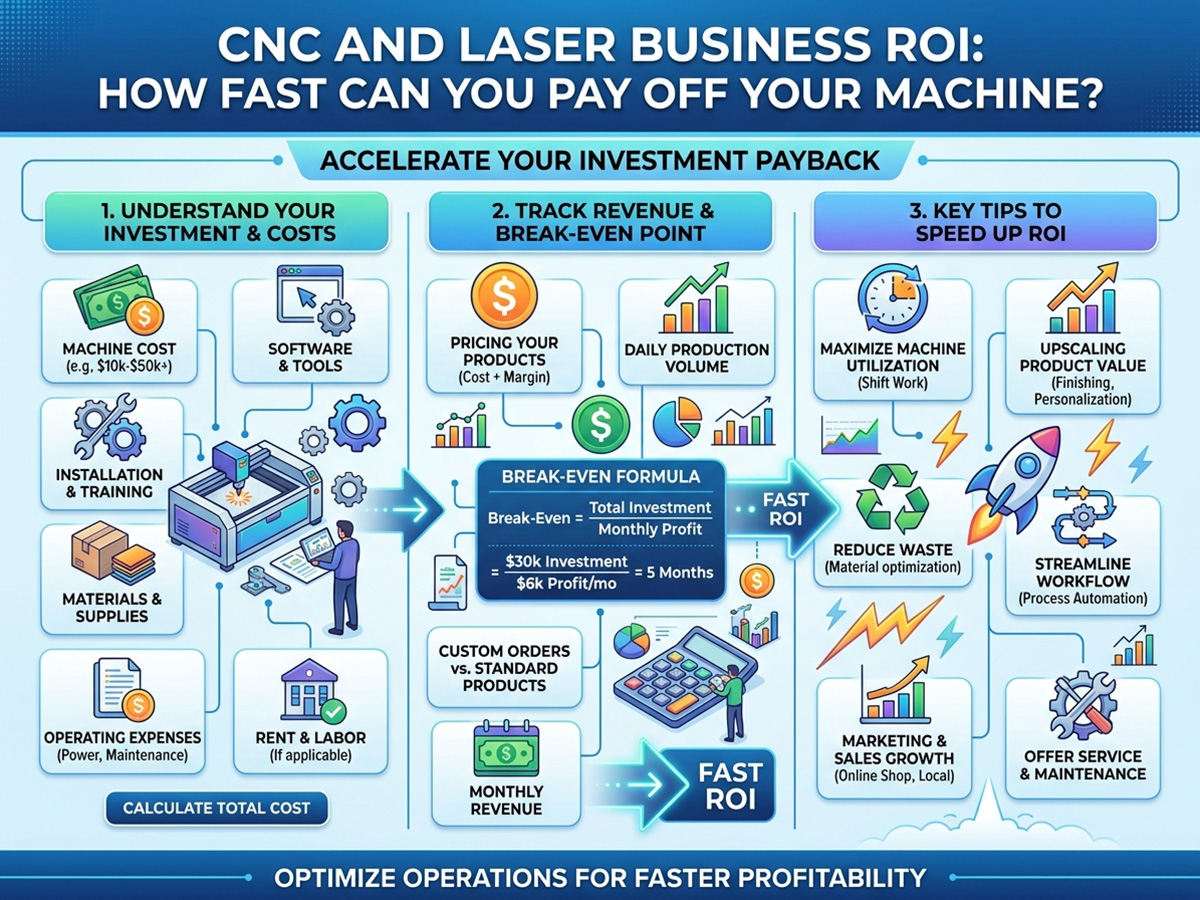
Payback Period (months) = Total Investment / (Monthly Revenue - Monthly Operating Costs)

If even your conservative estimate shows payback within 24 months, the investment carries manageable risk. If it only works in a best-case scenario, reconsider the machine size or your target market before committing.

Return on Investment Analysis for CNC engravers and Laser Machines

Common ROI Mistakes to Avoid

Experienced CNC and laser business owners across Reddit, Signs101, and WOODWEB frequently warn about these avoidable errors that destroy profitability. Avoiding these pitfalls is critical whether you are exploring laser engraver costs and benefits for a startup or scaling an established operation.

✓ Buying a $100,000 machine when a $20,000 unit covers 90% of your workload

✓ Skimping on CAM/CAD software and limiting what the hardware can actually produce

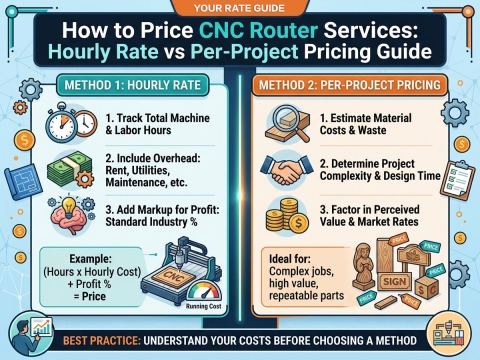
✓ Pricing products based on material cost alone instead of factoring in machine time, labor, and overhead

✓ Ignoring maintenance schedules and then facing catastrophic spindle or laser tube failures

✓ Assuming the machine will stay busy without active marketing, sales outreach, or an online storefront

✓ Calculating ROI using best-case utilization instead of realistic 60 to 70% beam-on rates

✓ Failing to account for the learning curve period when productivity is low and material waste is high

Which CNC or Laser Machine Offers the Fastest ROI?

The fastest payback depends on your business model, not the machine alone. However, certain categories consistently deliver quicker returns based on lower entry costs, broad market demand, and high per-unit margins.

商業模式Best Machine FitWhy ROI Is Fastest
Personalized gifts and decor (Etsy, Shopify, markets)CO2 laser engraver ($2K - $8K)Low entry cost, high margins (50 - 70%), strong seasonal demand
Custom signage and woodworkingCNC engraver ($5K - $30K)Repeat orders, labor savings, proven demand across industries
Metal fabrication (job shop or in-house)Fiber laser cutter ($30K - $200K)Eliminates outsourcing costs, handles thick metals, enables rapid prototyping
Cabinet and furniture productionIndustrial CNC engraver ($20K - $80K)Replaces multiple employees, nested cutting minimizes waste
Mixed material cutting (metal + nonmetal)Hybrid laser cutter ($10K - $40K)Single machine covers diverse jobs, reduces equipment redundancy

For entrepreneurs exploring how to start your business with a laser cutter, beginning with a versatile mid-range machine and proven product line minimizes risk while maximizing early cash flow.

Maximizing Long-Term Profitability After Payback

Once your machine has paid for itself, every subsequent dollar of revenue flows more directly to profit. The most successful CNC and laser businesses use these strategies to compound returns over time.

• Diversify product lines: Add complementary offerings. A sign shop with a CNC engraver can add laser-engraved plaques. A laser engraving business can expand into cutting services.

• Batch production: Group similar jobs together to minimize setup time and maximize uninterrupted cutting hours. Switching between materials and programs eats into productive capacity.

• Automate where possible: Material loaders, automatic tool changers, and job tracking software reduce manual intervention and increase throughput per operator.

• Reinvest strategically: Use profits from the 1st machine to fund a 2nd unit. Most shop owners recommend validating profitability before scaling, not buying the 3rd machine until the 1st 2 are clearly earning.

• Pursue high-value contracts: Corporate branding, architectural installations, and industrial parts carry larger order values and longer-term relationships than one-off consumer products.

How Fast Can You Pay Off Your CNC engraver or Laser Machine?

常見問題(FAQ)

How long does it take for a CNC engraver to pay for itself?

Most CNC engravers pay for themselves within 6 to 18 months depending on utilization and pricing strategy. Desktop models under $10,000 often break even in under 6 months. Full-size industrial routers typically recover costs within 12 to 18 months at consistent production volumes.

Is a laser engraving business actually profitable?

Laser engraving businesses routinely achieve profit margins between 50% 以及 70% on personalized products. Operators focusing on high-demand niches like corporate awards, wedding keepsakes, and custom home decor report the strongest returns with low material overhead.

What is a good utilization rate for a CNC or laser machine?

A utilization rate of 60% 至 80% is considered healthy for most shop environments. This accounts for setup time, maintenance, and material handling. Pushing above 85% is achievable in high-volume production but requires strict workflow optimization.

Can I start a CNC business part-time and still see ROI?

Part-time CNC businesses are viable, though payback periods extend proportionally. A machine running 15 to 20 hours per week instead of 40 may take 12 to 24 months to break even rather than 6 to 12. The key is maintaining pricing discipline and targeting profitable product categories.

What hidden costs should I include in my ROI calculation?

Factor in electricity, consumable tooling (bits, lenses, nozzles), software subscriptions, dust collection or exhaust systems, compressed air or assist gas, and preventive maintenance parts. Ignoring these costs inflates projected returns and leads to disappointing real-world results.

Should I finance or pay cash for a CNC machine?

Financing preserves working capital for materials, marketing, and operations. Many shop owners find that monthly lease payments are lower than their previous outsourcing bills, making the switch cash-flow positive from the 1st month. Equipment tax deductions can further offset total cost.

最後的思考

The math behind CNC and laser machine ROI is straightforward: total your costs, project conservative revenue, and divide. The nuance lies in execution. Owners who treat their machines as revenue-generating assets rather than workshop accessories consistently recover their investment faster and build more resilient businesses. Whether you are comparing laser engraver costs and earning potential for a 1st purchase or evaluating a capacity upgrade, grounding your decision in realistic financial modeling eliminates guesswork and positions your operation for long-term profitability.

如何創辦數控標誌製作公司 | 創業指南

2026-04-09前一則

沒有下一篇

延伸閱讀

STYLECNC iPhone 手機殼雷射雕刻機
2023-10-072 Min Read

STYLECNC iPhone 手機殼雷射雕刻機

STYLECNC 提供專業的數控解決方案,幫助您選擇合適的雷射雕刻機進行 iPhone 外殼雕刻。

3 軸 vs 4 軸 vs 5 軸 CNC 雕刻機
2024-01-028 Min Read

3 軸 vs 4 軸 vs 5 軸 CNC 雕刻機

您應該為您的 CNC 加工專案、想法或計劃選擇 3 軸、4 軸或 5 軸 CNC 雕刻機嗎?讓我們來了解一下3軸、4軸和5軸數控工具機之間的異同。

如何用雷射雕刻機在不銹鋼上打標顏色?
2022-05-203 Min Read

如何用雷射雕刻機在不銹鋼上打標顏色?

MOPA光纖雷射打標系統除了可以打黑、白、灰之外,還可以在不銹鋼、鉻、鈦合金上蝕刻顏色(橙、黃、紅、紫、藍、綠)。今天,我們將探討光纖雷射雕刻機如何在不銹鋼上標記不同的顏色。

雷雨天數控雕刻機需要做什麼?
2021-08-312 Min Read

雷雨天數控雕刻機需要做什麼?

夏季數控雕刻機容易發生一些事故,雷雨天需要做好哪些防護工作? STYLECNC 將在這篇文章中告訴你。

雷射雕刻的 3 種基本類型
2022-05-193 Min Read

雷射雕刻的 3 種基本類型

雷射雕刻有3種基本類型:雷射切割雕刻、凹雕和凸雕。讓我們開始學習雷射雕刻的基礎知識、工作原理、優點和類型。

如何在家雷射雕刻和切割木材項目?
2022-11-124 Min Read

如何在家雷射雕刻和切割木材項目?

您打算在家中雕刻和切割木材嗎?一個 CO2 雷射切割機和雕刻機可以幫助您輕鬆地為業餘愛好和商業用途製作客製化木工項目,以啟動或發展和擴展您的業務。

發表您的評論

1 至 5 星評級

與他人分享您的點子和感受

點擊更改驗證碼